
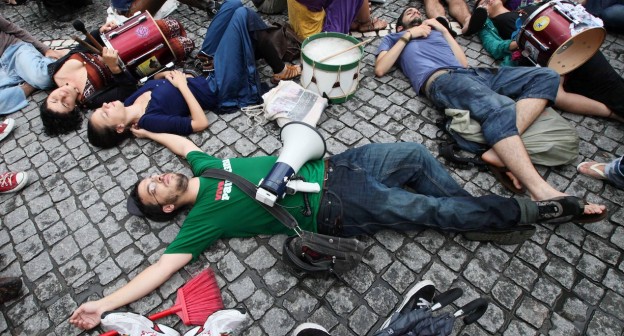
A haunting banner flown by young Spaniards on Peurta del Sol last year so elegantly captured the dynamic that both the young of Europe and it’s officials are finding increasingly hard to ignore. Something has to give, and everyone knows it. The last two words are no idle threat, they merely report the facts, and they should chill every E.U politician to the bone.
Europe’s youth have been the worst hit by the 2008 crash and the sovereign debt crisis that ensued. They will be the first generation since WWII to have fewer opportunities than those available to their parents, as well as a poorer standard of living. They are also most educated generation of young Europeans ever, and the first in modern times to give the lie to the idea that higher education and job prospects go hand in hand. With one in four under the age of thirty now unemployed and 46% of under -34 year-olds still living with at least one of their parents, the image of the thirty-something Masters holder still sleeping in his or her childhood bed is shockingly common. E.U officials now have a powerhouse of young, intelligent, tech-savvy, connected, motivated and disillusioned people to contend with. The same demographic that in more hale and hearty times would be viewed as the future of the Union, may now carry with it the very seeds of Europe’s destruction.
And even among Europe’s insulated governing class the message is getting through loud and clear. German Finance Minister Wolfgang Schaeuble was unequivocal about his forecasts for the future of Europe in a statement he made yesterday. Essentially, if youth unemployment in Europe is not addressed, there is no future for Europe. Even more emphatic were his warnings that dropping the European welfare model in favour of a tougher U.S system would be instantly catastrophic.
“We need to be more successful in our fight against youth unemployment, otherwise we will lose the battle for Europe’s unity,” Schaeuble urged yesterday at a conference in Paris, also saying that the dissolution of Europe’s welfare system would lead to: “revolution, not tomorrow, but on the very same day.”
Last month Eurostat revealed the true extent of the problem for the first quarter of 2013. The worst affected areas of the E.U were Portugal, Italy, Spain and Greece with youth unemployment rates of 38.3%, 38.4%, 55.9% and 59.1% respectively. The figures being quoted for Spain and Greece since the report are as high as 57% and 64.2%. Meanwhile Germany and Austria’s unemployment are both below 8%.
Spain’s Prime Minister Mariano Rajoy was the most vocal at the meeting, and the only one who put forward any concrete proposals. He suggested that the European Investment Bank triple its aid to small businesses (many of which in southern Europe are finding it extremely difficult to secure loans), bringing the figure up to 30 billion euros. He also called for a form of “common European debt”, where governments are allowed to subsidise the hiring of young employees, temporarily excluding these expenditures from their budget deficits so as to be able to meet their fiscal targets.
The proposals are likely to be met with resistance but Germany, well aware of the resentment growing in many European countries against it, is starting to take the first steps towards addressing the issue. These involve securing bilateral agreements with Portugal, Spain and Greece, in addition to 6 billion euros having been earmarked for boosting youth employment in 2014-2020.
At the moment however real action seems to be very thin on the ground, unlike the steadily swelling masses gathering to vent their frustrations.